
Information
Pairing AI with skilling could add up to $6.6T to the U.S. economy by 2034 and deliver the return on investment businesses want DAVOS, Switzerland, Jan. 19, 2026 /PRNewswire/ -- New research from Pearson (FTSE: PSON.L),
Original sourceAI Summary
Pearson's new report emphasizes that the integration of AI with continuous learning could add up to $6.6 trillion to the U.S. economy by 2034. The key to realizing this potential is addressing the 'learning gap' to ensure workers possess the necessary skills to fully leverage technology. This focus on skilling could drive substantial economic benefits.
Sentiment Rationale
Historically, companies that proactively adapt resources to align with technological advances and workforce needs often see a positive impact on their stock price. Pearson actively addressing the skills gap through advancements and partnerships positions it favorably in a changing market.
Trading Thesis
Buy PSO as increased focus on AI learning tools may improve market perceptions and revenues.
Market-Moving
- Potential $6.6 trillion economic impact could drive demand for Pearson's services.
- Increased emphasis on skilling may boost Pearson's growth and share price.
- Job reskilling urgency could increase demand for Pearson's educational products.
Key Facts
- Pearson's research shows AI could add $6.6T to US economy by 2034.
- AI's potential hinges on developing worker skills alongside technology.
- Pearson emphasizes overcoming the 'learning gap' for productivity gains.
- Employers must prioritize learning to leverage AI's economic benefits.
- 59% of the workforce needs reskilling by 2030 for effective AI use.
Companies Mentioned
- Deloitte (N/A): Alliances with firms like Deloitte may enhance Pearson's market presence.
- IBM (IBM): Collaborations with IBM for AI tools could strengthen Pearson’s product offering.
Industry News
The article fits 'Industry News' as it discusses broader impacts on economic productivity and workforce dynamics related to AI and education. This relates directly to Pearson's strategic focus in providing educational resources for adapting to technological changes.
Pairing AI with skilling could add up to $6.6T to the U.S. economy by 2034 and deliver the return on investment businesses want
DAVOS, Switzerland, Jan. 19, 2026 /PRNewswire/ -- New research from Pearson (FTSE: PSON.L), the world's lifelong learning company, reveals that the true economic potential of AI will only be realized if employers pair technology investment with continuous learning. The report, "Mind the Learning Gap: The Missing Link in AI's Productivity Promise", released today at the World Economic Forum's Annual Meeting, finds that augmenting jobs with AI - rather than simply replacing workers – and ensuring employees have the skills needed to work effectively with AI could add between $4.8 trillion and $6.6 trillion to the US economy by 2034. This represents around 15% of current US GDP at the lower range.
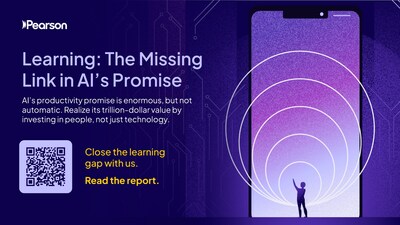
AI Won't Lift Human Productivity Without Learning, New Pearson Research Finds
The Productivity Paradox: Why AI Alone Isn't Enough
Companies are investing billions worldwide on AI infrastructure and models, yet there are few positive examples of enterprise-level productivity gains, outside of coding, that truly help workers and drive ROI. The return on AI investment for companies today is often targeted at replacing workers, driving further uncertainty and worry in workplaces. While many employees report "time saved" through AI, the broader economic uplift remains elusive. Pearson's research reveals that a critical "learning gap" is the missing link preventing both employers and their workers from fully leveraging AI's potential.
"AI will drive profound long-term change to business and industry. But leaders are under pressure to rapidly adopt AI and demonstrate a return on that investment, all while bringing worried employees along with this seismic shift. Every positive scenario for this AI-enabled future is built on human development," said Pearson CEO Omar Abbosh. "As a learning company, we see that the biggest obstacle to AI adoption is the lack of human skills to work alongside these technologies. Addressing that will support workers, boost their confidence with new technology, and drive the ROI outcomes that businesses want."
The "How To": Pearson's New Roadmap for Learning in the Age of AI
Based on its longstanding expertise in learning science, Pearson's report proposes a new approach to workplace learning, one that flips that traditional model of "deploy tech, then have people adapt to the system." The report notes that the most powerful productivity gains come when technology deployment and skill building happen together and provides the C-suite with four actionable steps to do that, called the DEEP Learning Framework:
- Diagnose and define a task-level augmentation plan;
- Embed learning seamlessly into the flow of work;
- Evaluate and measure skills progress toward an AI-augmented workforce; and
- Prioritize learning as a core strategic investment.
The report emphasises that employers risk missing the productivity prize if they focus solely on technology deployment while neglecting the human side of AI adoption. AI has reached more than one billion users in just three years, yet learning is not keeping pace. That's driving a growing emotional and economic toll as workers risk losing jobs and their competitive edge. According to the World Economic Forum, 59% of the global workforce will need reskilling by 2030, underscoring the urgency of solving the learning gap through implementing new models.
The full report and its findings are based on a quantitative analysis that combines Pearson's Faethm data with a comprehensive academic and industry literature review and expert interviews, allowing us to model both the economic impact of AI‑augmented work and the organizational practices needed to close the learning gap.
Read Pearson's new report in full: https://pearson.com/ai-learning-gap
Recent Pearson News
- Pearson and Deloitte announce new alliance
- IBM and Pearson Collaborate to Build New AI-Powered Learning Tools
- Pearson Launches AI-Powered Communication Coach
- Pearson Launches Revibe Wearable to Help People Build Focus and Boost Learning
- Pearson Launches AI Literacy Modules to Help Instructors Teach Responsible AI Skills
About Pearson
At Pearson, our purpose is simple: to help people realize the life they imagine through learning. We believe that every learning opportunity is a chance for a personal breakthrough. That's why our c. 18,000 Pearson employees are committed to creating vibrant and enriching learning experiences designed for real-life impact. We are the world's lifelong learning company, serving customers in nearly 200 countries with digital content, assessments, qualifications, and data. For us, learning isn't just what we do. It's who we are. Visit us at plc.pearson.com.
Media Contacts
Sami.Miller@Pearson.com – US
Laura.Ewart@Pearson.com – UK
 View original content to download multimedia:https://www.prnewswire.com/news-releases/ai-wont-lift-human-productivity-without-learning-new-pearson-research-finds-302663501.html
SOURCE Pearson